


By Elia Gandolfi, Het Shah, Suresh Unnikrishnan and Meenakshi Garg

When a technology-enabled nonprofit scales into new geographies and reaches millions of users, sooner or later it has to hand over implementation to someone else: a state government, a ministry, a local partner. A critical step in supporting third parties is transitioning the underlying platform: the software and documentation that support operations, engage users, track outcomes, and produce dashboards for program management. In this transition, nonprofits face common challenges: the platform is usually built for one organization, in one context, by the engineers who still watch over it every day. Each new geography requires custom development and deployment; handovers typically proceed without long-term customer support or upgrades. The private sector solved a similar problem years ago with the vertical SaaS (software-as-a-service) approach. The social sector is now catching up.
This piece outlines how Rocket Learning is approaching this challenge, and how The Agency Fund’s Accelerator will turn Rocket’s experience into learning for others. It’s intentionally an early story: the goal is sharing nascent lessons and building together the next horizon of scale-up for the social sector.
The challenge: Platforms built for one operator
Rocket Learning delivers play-based early childhood development (ECD) content to India’s Anganwadi system, the world’s largest daycare network, through WhatsApp groups for Anganwadi workers and the parents of preschool children. After six years across fifteen states, the program runs on the admin platform Rocket built in-house, with user management, a content calendar for the academic year, WhatsApp delivery and automated nudges, field visit logs, and dashboards.
The first opportunity to scale outside of India came when VélezReyes+, a philanthropic organization in Latam, partnered with Rocket Learning to incubate Aprendo+, as an independent, locally led organization adapting Rocket’s model for Peruvian parents and teachers, supported by Rocket’s technology platform. They went live in late 2024 and have reached +8,700 children in 2026 so far. While successful overall, the experience has exposed the challenges in transitioning from a single-operator platform to a multi-tenant solution. Earlier, onboarding journeys and engagement nudges were “hardcoded” for the Indian context, including time zones; program logic for teachers and children was built into the code.
The solution: How the SaaS model enables scale
Commercial software providers long ago settled on a cost-effective model: the vertical SaaS approach, where one modular and configurable product adapts to each customer’s needs, with a customer-success team ensuring that product value is maximized. Each customer operating the platform works in its own protected space, with its own data and authorized users, and adapts the product by configuring it rather than asking for custom changes. Improvements shipped to one customer reach all of them. And the vendor maintains a support team that understands user challenges, facilitates solutions, and iterates—because nobody expects a customer to figure out a complex product from day one.
Rocket’s engineering team summarizes its target in the same terms:
build once, reuse everywhere, deliver locally
configure, don’t customize
isolation of data and components by default
What began as one inbound request to bring Rocket’s model to Peru became an organization-wide priority that more partners can benefit from.
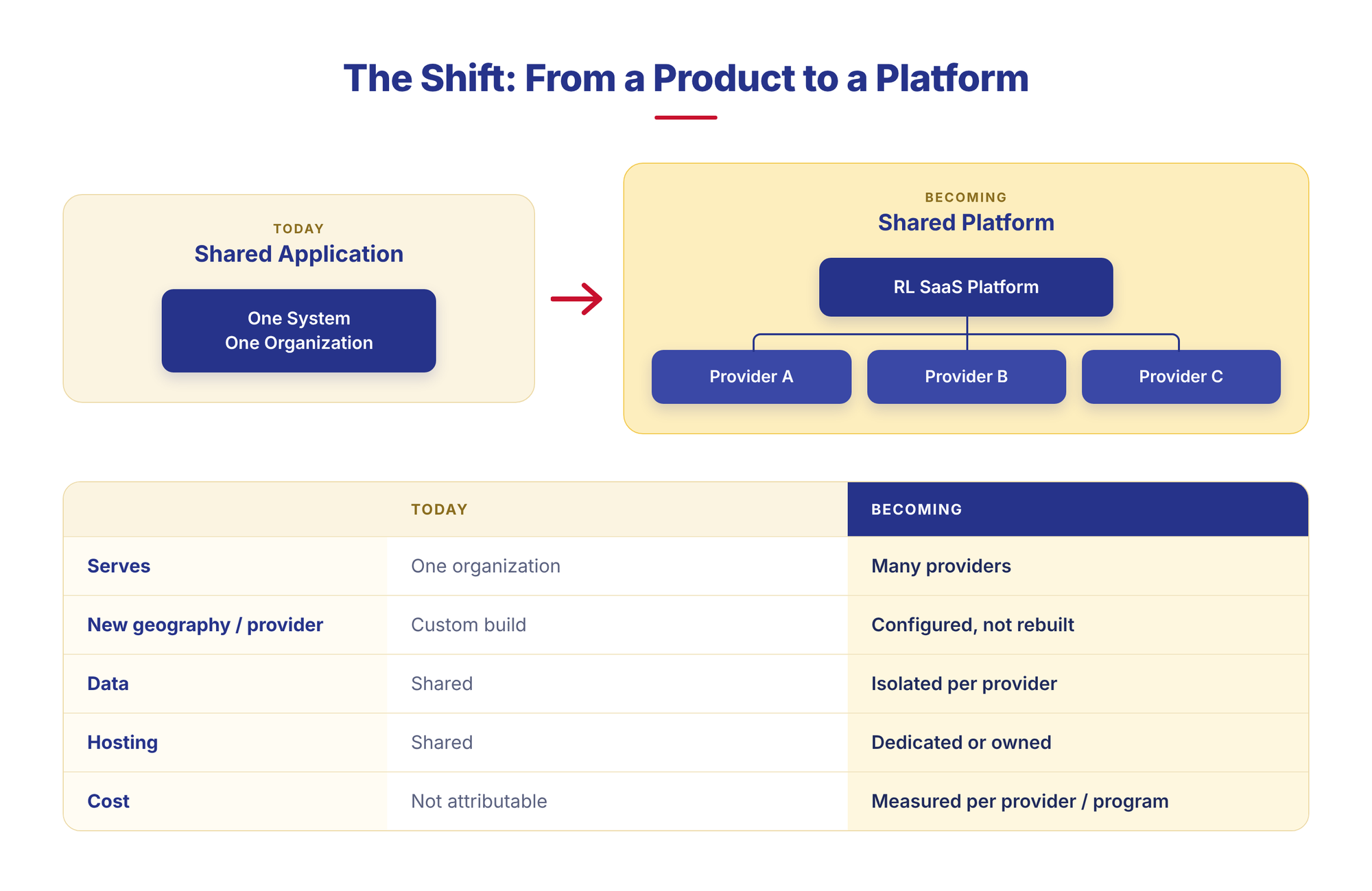
Indeed, the social sector does have software platforms designed for others to run, particularly for field data collection. But these are often product-first organizations that do not deliver last-mile programs themselves. We are describing a different model: an implementer that ran a sector-specific program directly for years is now generalizing the platform behind it. This is a problem that technology-enabled last-mile implementers will face when aiming to scale globally.
How it works and where it stands
Rocket Learning is evolving from a single-country program operator into a software and services provider that can support multiple organizations or “tenants” across geographies, without disrupting its core delivery commitments:
A program provider is the entity that uses and pays for the platform, and ultimately brings the intervention to the end-users. This organization runs a program using the platform as a scaffold, with its own geography, users, roles, and content.
A platform provider is the entity that builds and hosts the multi-tenant platform, providing configurability that allows the software to adapt to different models of program implementation. The provider monitors platform performance, offers customer support, and continually ships improvements.
With a multi-tenant platform, the same code can serve a domestic partner sharing Rocket’s infrastructure, an international partner with a platform deployment managed by Rocket, or a government hosting everything on its own servers. What a tenant can configure is deliberately broad, from content journeys and nudge rules to dashboards, roles, and ticketing, while the core automation logic and the isolation model stay locked.
What Rocket is learning
Build with scale in mind, while prioritizing stability. One thing Rocket would do differently is prioritize multi-tenancy from the outset. But that does not mean building a full SaaS on day one. It means making the right choices early, while the product still serves one country or one state: structure the data so it can be made multi-tenant tomorrow; keep language, time zone, and program rules out of the code; set up serverless architectures that can operate on customer data, and allow the entire stack to be replicated on another cloud if needed. This can also mean picking the channels that already scale for your users (i.e., WhatsApp) rather than building your own tablet or mobile app. In an operationally heavy environment, where users are not digitally native, the advice is to spend at least a year understanding what people can actually handle, build the system needed for that scenario, and generalize from there. Rocket started generalizing its platform after years of running a stable product across many Indian states: once you have enough exposure and stability in your product, most of the engineering can be pointed at the new platform while a small team keeps the original version running.
The software doesn’t replace people. SaaS is not ‘hand-over and disappear’. Successful transition relies on both strong local implementation teams, capable of adapting and delivering the model in their own contexts, and formal Customer Success and Forward Deployment teams supporting them. Every week, a Rocket team member meets the Peru team to answer questions, guide new launches, and route bugs; as the scale of the work together grows, those meetings also grow longer. Separating Engineering and Customer Success teams is an organizational choice that ensures enough resources are dedicated to local deployments.
SaaS offers economies of scale. In addition to scaling, a program can achieve greater impact by reducing the cost-per-user. The SaaS model eliminates the cost of rebuilding a software platform (and maintaining a dedicated engineering team) in every state or country in which a program operates. It can enable an organization to scale its model with fidelity, but without deploying its own staff on the ground. For tech-enabled organizations, this represents a significant budget saver. It can also promote sustainability– for example, governments can run the program with existing hires on their own servers, or negotiate tech deals that a nonprofit cannot. Rocket provides and maintains the platform, ships new features, and supports customers at cost, handing over all three parts of its program to third parties: platform operation, content development, and field operations. By generalizing its product and offering customer services, Rocket’s goal is to bring cost per child from about $1.40 to $1 by 2031, working through partners to reach 22 million children aged 0-6 annually. And because technology is the scaffold, Rocket expects to continue experimenting and improving – which will be critical for maintaining high user engagement and learning outcomes as the program moves from India to partner geographies.
It is an investment and it needs prioritization. None of this progress came by itself. The SaaS model is an organization-wide objective at Rocket, with its own OKR, a dedicated platform team, senior engineering hires, and a Customer Success unit that did not previously exist. Engineering runs three streams in monthly sprints: the multi-tenant platform, priority fixes on the current version, and operational requests, with design done upfront and only business-critical changes accepted on the old version of the platform. It also needs the right partners on the provider side. Governments and other third-party operators will need to come with a budget line for adoption of Rocket’s platform, a team willing to be trained, real alignment on outcomes, and patience—because full integration is a long process.
Learning together
Rocket Learning is one organization, in one sector, one year into this transition. Every last-mile technology-enabled organization that scales through governments and third parties will likely meet the same challenges at some point, whether they deliver agricultural advisory services, health messaging, or youth employment support. No one should have to rediscover the answers alone.
That is what The Agency Fund’s Accelerator is for: a learning ecosystem made of shared tooling and playbooks, reference architectures, evaluation methods, product and engineering best practices, and scaling strategies, so that a lesson learned in early childhood education in India is available to a health program in Kenya or an entrepreneurship initiative in Indonesia. We call this particular problem the challenge of scalable platforms: what it takes to get an organization’s program from a system monitored by the engineers and managers who built it, to one that a third party can operate on their own.
Follow Rocket Learning and The Agency Fund’s blogs to hear about progress.
Elia Gandolfi is a Product Manager at the Agency Fund
Het Shah, Suresh Unnikrishnan and Meenakshi Garg are respectively Operations and Analytics Lead, Head of Engineering and Head of Product at Rocket Learning