

Learning from the World’s Largest Math Olympiad
Emerging insights from a new collaboration in Brazil

By Patricia Andrews Fearon, Roberta Costa, Fernanda Estevan, Diana Moreira, and Nathalia Sales
Mathematical potential is widely distributed, but the opportunities to develop it are not. Students from disadvantaged backgrounds remain underrepresented in STEM courses and careers. Many students with a deep curiosity for math grow up without exposure to role models, mentorship, or clear pathways into scientific fields. Even when their abilities are similar, structural barriers, informational gaps, and social identity pressures can make persistence in mathematics more difficult.
Recognizing this gap between potential and opportunity, in 2022 The Agency Fund ran a call for proposals focused on discovering and nurturing exceptional mathematical potential among socioeconomically disadvantaged youth. We wanted to support research and innovation to learn how organizations and governments can best identify strong performers at scale and strengthen pathways for these students to grow.
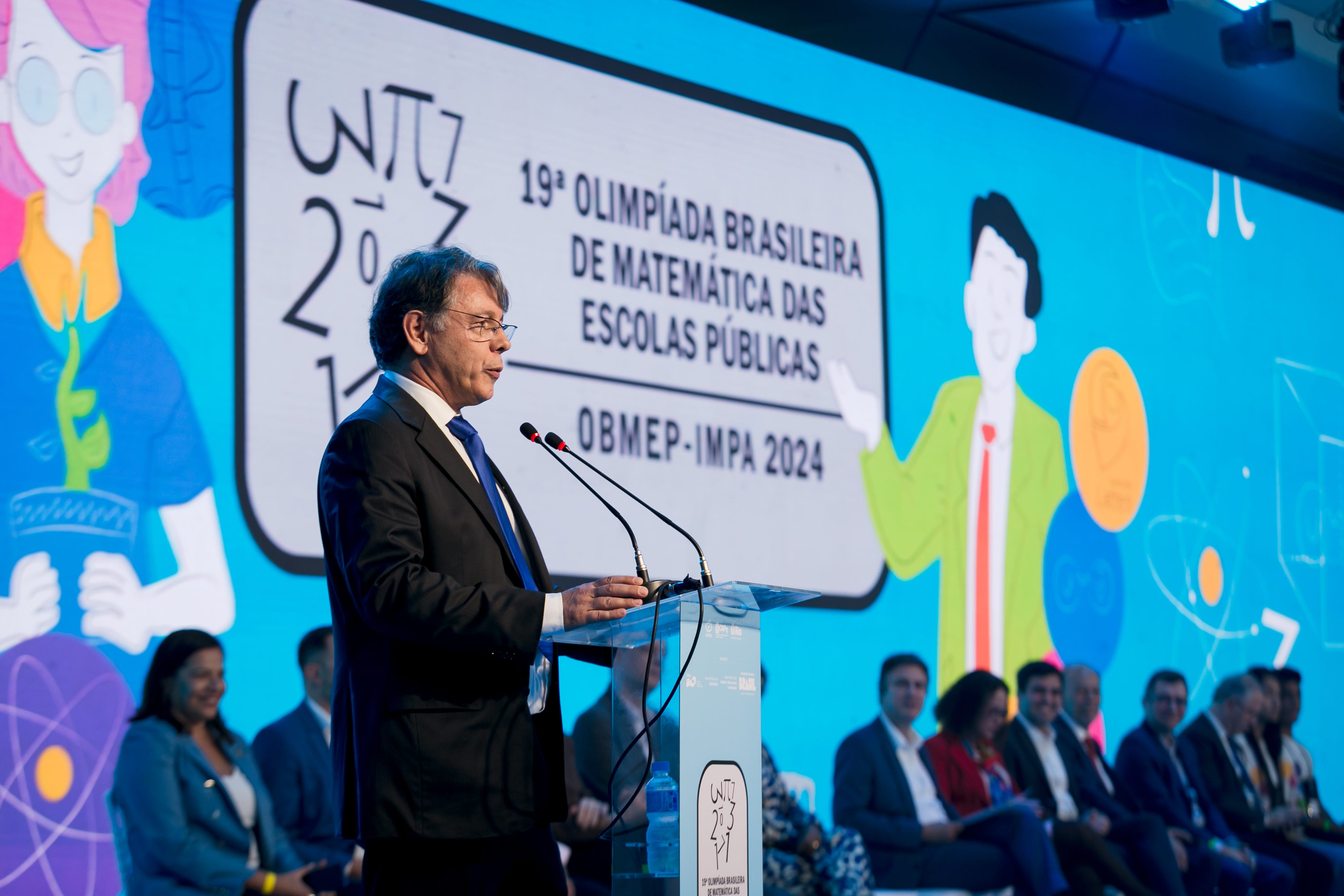
That search led us to an extraordinary program: the Olimpíada Brasileira de Matemática das Escolas Públicas (OBMEP), the largest math competition in the world.
Each year, more than 18 million Brazilian students participate in OBMEP. Organized by the Instituto de Matemática Pura e Aplicada (IMPA), Brazil’s leading institution for mathematical research and education, the Olympiad operates as a two-phase national competition embedded in public schools. Schools voluntarily enroll their students, administer a first-round exam locally, and send qualifying students to a second phase held simultaneously across thousands of testing centers nationwide, with top performers awarded national medals and honorable mentions.
Beyond the competition itself, OBMEP creates long-term opportunities for mathematical development. Medalists are invited to year-long advanced training programs run by university hubs; top performers attend intensive camps and mentorship programs; and some students receive multi-year scholarships that support their university studies in mathematics and related fields.
Over two decades, the program has identified and nurtured mathematical potential at a national scale. That scale creates something rare: a living laboratory for understanding how mathematical excellence develops over time – and how institutions can better cultivate it.
From identifying talent to developing it
Math Olympiads are often associated with rare brilliance – the idea that a small group of students simply “have it.” But research shows that mathematical ability can be strengthened through instruction and practice. There is also a growing interest in how relatively small interventions can shape students’ aspirations and persistence. Exposure to relatable role models, signals that effort and curiosity are valued, and institutional cultures that emphasize growth and improvement can all influence who continues engaging with mathematics and who opts out.
The question, then, is not only how to identify exceptional students, but how to create environments that help many more students stretch beyond what they initially believe is possible. This matters particularly for students who may have internalized messages that mathematics is “not for people like me.” Girls and socioeconomically disadvantaged students, for example, often receive signals that mathematics is not for them – a pattern widely documented in the evidence. A growth-oriented institutional culture can expand who sees themselves as capable of mathematical excellence.
OBMEP has already done something remarkable: it exposes millions of students to rich, non-routine mathematical problems. For many, it is the first time they encounter mathematics as creative reasoning rather than rote procedure. Over time, placing greater emphasis on effort, strategy, mentorship, and improvement could further expand these benefits. This kind of shift could influence Brazilian students’ educational trajectories and performance, career aspirations, and long-run participation in STEM fields.
What we’ve learned from working with OBMEP
Since 2024, The Agency Fund has worked with a research team – led by professors at the University of California, Davis and the São Paulo School of Economics – to study the effects of OBMEP. This collaboration has combined academic research with operational work alongside IMPA’s in-house data team, generating new insights about how the program shapes student outcomes and how it can continue to improve in practice.
This includes analysis of two decades of OBMEP administrative data covering students’ participation, performance, scholarship receipt, and involvement in training programs. For example, the research team recently released a working paper by Diana Moreira and Fernanda Estevan on OBMEP “peer spillovers,” or how student achievements in the competition affect their classmates. The paper shows that when a student narrowly wins an honorable mention – awarded to the top 4% of participants – their classmates are more likely to participate in the competition later and to score above the 90th percentile. These spillovers – which are approximately one-sixth as large as the direct effects on the honorable mention recipients themselves – are concentrated among high-achieving students in the same classroom and operate primarily through shifts in aspirations and beliefs rather than resource reallocation.
Beyond identifying short-run academic effects like these, OBMEP records can be linked to longer-run data, including higher education enrollment records and labor market data. This makes it possible to follow students over time to understand the life-course effects of OBMEP participation. This kind of rich, longitudinal data allows researchers to examine questions that are almost impossible to study elsewhere. For instance, ongoing research examines how participation in OBMEP affects school-level performance and enrollment patterns, how medalists’ long-run outcomes evolve over time, and whether these impacts vary across socioeconomic backgrounds.
In addition to long-run research, our collaboration with IMPA supports more immediate routine analysis to help refine how OBMEP operates in practice. Recent work led by OBMEP’s in-house data team, with support from the research team, examines participation patterns among students who qualify for the competition’s second phase and factors associated with exam attendance.
By combining administrative, socioeconomic, and geographic data, the team is identifying which groups face the highest risk of non-attendance so OBMEP can design more targeted communication and support strategies. These insights may not always generate academic research, but they are critical to institutional improvement.
Looking ahead
Our work with OBMEP began with a different idea. Inspired by previously funded research showing that aspirational narratives can improve student performance, the collaboration initially focused on designing and evaluating a role-model film intervention, with a nationwide randomized evaluation planned through support from USAID’s Development Innovation Ventures program. When that funding was terminated amid broader US policy changes, the team took a step back to reassess. What became clear was that OBMEP’s appeal extends far beyond one intervention opportunity: it is a national platform with extraordinary data and reach.
That recognition has led to a broader effort to build a Brazilian Math Learning Lab – an initiative that leverages OBMEP’s infrastructure and works alongside its team to better understand how mathematical potential develops and how institutions can nurture it at scale. By situating our collaboration alongside OBMEP and IMPA, we aim to create feedback loops between data, experimentation, and operational decision-making – an approach that reflects The Agency Fund’s broader goal of embedding learning within organizations. Instead of producing isolated studies, embedded labs can enable programs to continuously learn from their own data and refine their operations.
As this work evolves, we are actively exploring new partnerships and projects that can contribute to this effort. The goal is simple: to turn one of the world’s largest math competitions into a platform not only for discovering talent, but for learning how to nurture it more effectively over time.
Patricia Andrews Fearon and Roberta Costa are from The Agency Fund’s technical team. Fernanda Estevan is an Associate Professor at the São Paulo School of Economics.
Diana Moreira is an Assistant Professor of Economics at the University of California, Davis. Nathalia Sales is a Postdoctoral Researcher at IMPA.