


By Jamie Walsh
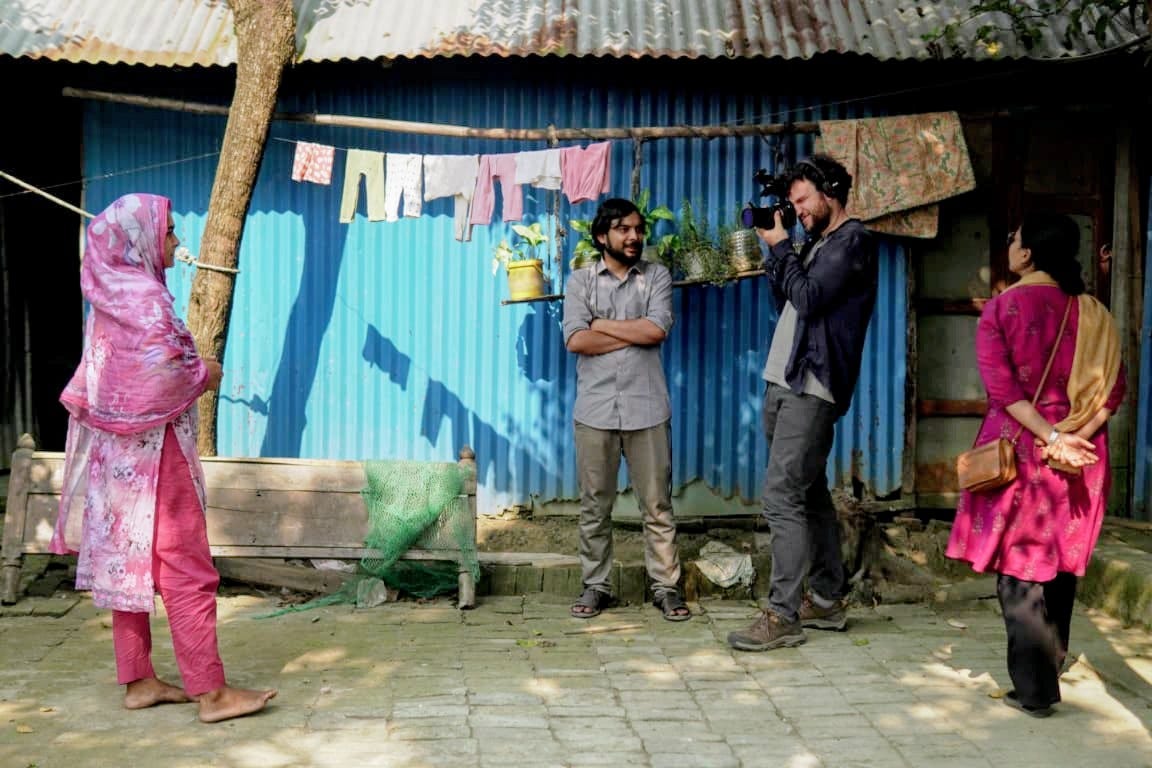
One of the original inspirations for The Agency Fund was that film can be a remarkably effective way to create social impact.
In Uganda, students who watched Queen of Katwe, a movie about a young girl chess prodigy, did better on their maths exams. The effect was largest for girls, closing the performance gap with boys.
In rural India, women in villages that got cable television reported more autonomy and less acceptance of domestic violence. Son preference fell by 12 percentage points. The number of situations in which women considered wife-beating acceptable dropped by about 10 percent.
So we planned to experiment with shooting films in Kenya with two of our partners, Educate! and Shamiri. We were fortunate to connect with filmmaker Michael Clarke, who joined us in Nairobi for our first filming session just a week after having connected with us on a videoconference.
Having produced dozens of shorts and a few feature-length films, we have gained conviction that films can do something for development that our usual tools cannot. When we make films, we are able to do three things.
1. Center the story on the people driving development
The development sector has built sophisticated tools for measuring cost effectiveness and social returns on investment. But the very tools that enable strategic decision-making for funders also necessitate radical simplification of human experience, in order to make problems “legible”: to simplify, standardize, classify, map, count, and regularize complex social and ecological practices so we can refine programs.
Bogged down in point estimates and empirical strategies, it can be easy to forget the lives of the people who actually drive development: frontline workers who extend their hours to serve their communities; mothers and fathers who adopt new practices to nurture their children; young people who move to cities with barely a safety net, to pursue a better future for themselves and their families.
The Agency Fund’s films try to bring those people back into focus.
For example, our film A Powerhouse of Women follows Sunita, an Anganwadi educator in Uttar Pradesh who has served her community for twenty-one years. The parents of the children now at her daycare center grew up with her. Nearby, Diksha took the same job at 750 rupees a month because she wanted to earn her own money. Although their government daycare centers close at two in the afternoon, the children say they don’t want to leave until three.
Another one of our films, Threads of Care, follows families across Nepal, Indonesia, India, and Bangladesh at the moment they bring children into the world. We meet a mother of young twins whose family shares a single phone; a woman caring for a newborn alone, while living far from the nearest hospital; and families searching for information they can trust.
These films highlight the human qualities of ordinary life that make development worth caring about: love, determination, resourcefulness, care. They expose the agency people exercise when navigating difficult conditions, steadily moving toward a more prosperous, fulfilling future.
2. Shed light on details that data doesn’t surface
Most of us at The Agency Fund are happiest working with data. We build and evaluate AI tools. We run experiments. We help organizations build data warehouses. We do this because data is central to improving how social services get delivered. But data, on its own, captures what has been called a “thin description”: precise and narrow.
Film captures a thick description of the world: the context, motivations, and relationships that make an action meaningful. It’s what renders behavior intelligible, not just countable.
In Taking the Alternative Path, Precious wakes at 5:30 in the morning and heads to the market in Kitui by six. She dropped out of school when she became pregnant, and now she works to give a better life to her daughter. She sells shoes – sizes 38 to 40, the most common in Kenya – and dreams of being a boss. An employment survey could count her as self-employed. But that would miss the complex business operations she manages, calculating which stock to carry, whether to trust a friend as a business partner, and how to improve her digital marketing.
In Simmering Point, Stephen lost a young cousin as a teenager and had no space to talk about it. He found an outlet through music, performing at his church, which gave him both a way to process what had happened and a community to belong to. A mental health survey might have flagged him as at risk. But it would miss the music, the church, and what they meant for his emotional development.
3. Inspire others to adopt what’s working at the frontier
We have the privilege of working with some of the most innovative organizations in the social sector. They deliver critical social services – like caregiver training, business mentorship, and community-based mental health care – to people navigating difficult challenges. Beyond the immediate impact they deliver, they are improving their effectiveness each quarter, by building data systems that help them continuously track performance, iterate, and experiment.
While it is helpful to draft playbooks on data management practices and experimentation, we’ve found films to be an effective way of communicating the gist of the underlying ideas in an accessible way.
Good ideas travel faster when people can watch them work.
For instance:
Our film on building data systems describes the data infrastructure nonprofits need to be able to tell how their program is working at a given point in time.
Our user funnels film describes how organizations can organize their user’s journey into a set of metrics that can be tracked and improved over time.
In our A/B testing film, we show how nonprofits can continuously improve their program through experimentation.
Our film on building digital hubs describes our work with Shamiri, focused on building infrastructure for scaled service delivery.
Our short on evaluating AI products describes our 4-level framework for building and testing AI products.
What do we learn from film?
Many of us come from the world of evidence. We have spent years conducting randomized trials, constructing careful measures of development, or developing logframes for social programs. This background can naturally raise a question about the value of film. What do films – non-representative, emotionally charged, and biased by the filmmaker’s perspective – actually buy us, in terms of learning?
I have argued before that stories are a radically underappreciated form of knowledge in policy and social science.
One way to see this is the different kinds of knowledge the methods produce. Randomized trials generate propositional knowledge: knowing that something is true. Teaching at the right level, for example, has improved children’s learning. We know this from dozens of randomized trials. Films, on the other hand, generate procedural knowledge: knowing how something works in practice. This is how delivery actually happens, and it gets closer to what the people involved are actually trying to accomplish. They can be thought of as a scaled version of social learning. Development needs both.
But there’s another, perhaps deeper, epistemological perspective that story and narrative offer development, which is to celebrate the profound and mysterious beauty of the human condition. Whenever we get impressive A/B test results, my excitement is tempered by the cautionary note of the great development economist Albert Hirschman:
“We should treat human beings as something fairly precious and not just something you can play upon. You see, if you ever could figure everything out, if you could have a social science that really is a science, then we would be the first ones to be disappointed. We would be dismayed because if we become like that, we could be figured out. And that means that we are not worth as much as we think…. Were we ever to succeed, then we would have failed!” (Swedberg, 1990, pg. 166)
What a fantastic read! I am of the same, exact opinion - sharing a link my team and I worked on (if you are interested) with 5 short films that capture that 'thick description' you mentioned: https://lnkd.in/e5s3EqvV. Film is more powerful than most can understand. More power to you!